Accounting & Tax
Identify the correct RUC or NT for a property sale in Panama. Compare Basic and Premium support for individuals, companies and foreign owners.
A sale of real estate in Panama is not simply a matter of signing a purchase agreement. The seller must be properly identified by the Dirección General de Ingresos (DGI) so that the applicable real estate transfer and capital-gains filings can be managed. Missing or inconsistent taxpayer details can complicate the closing even when the seller has owned the property for years.
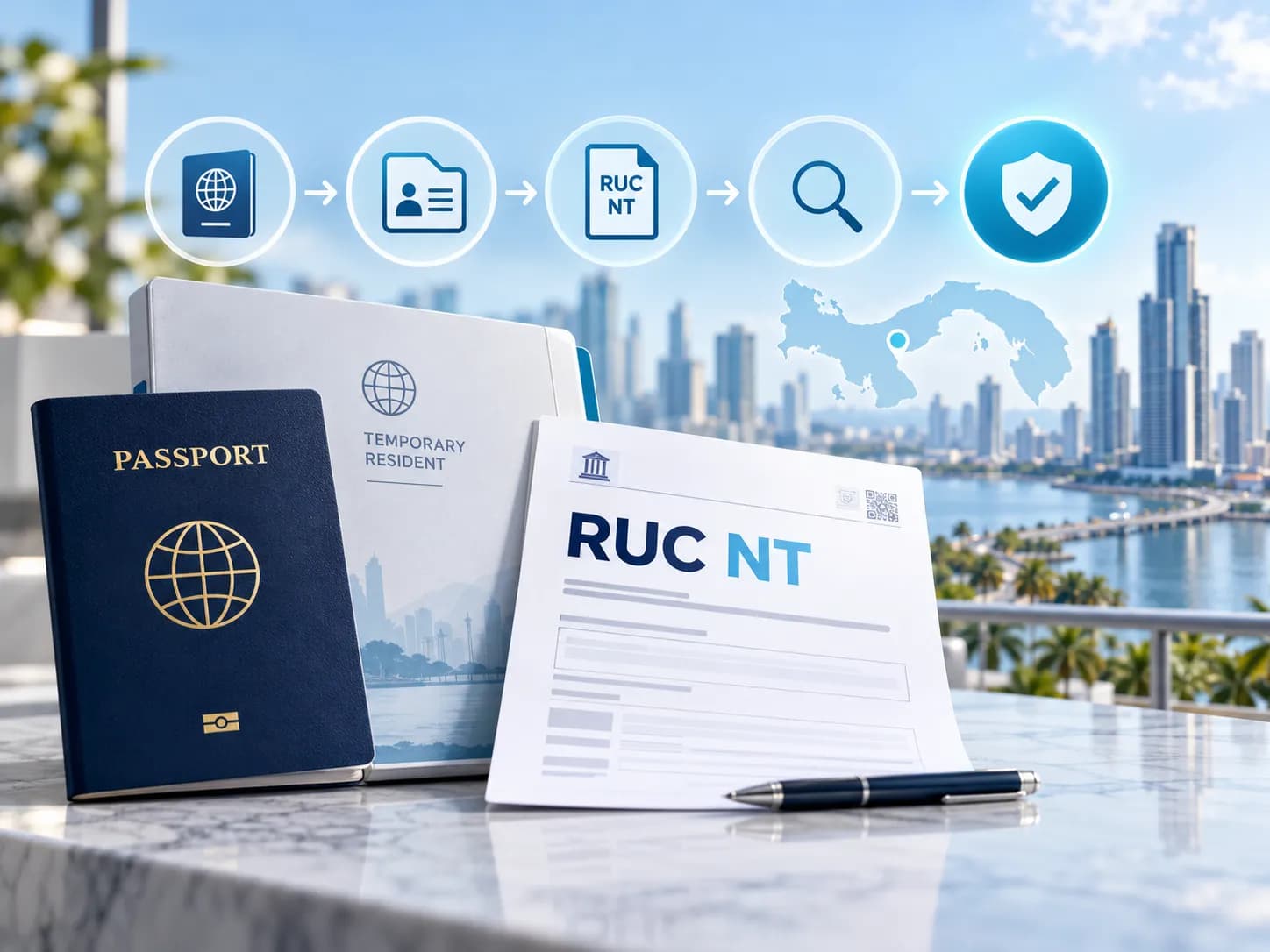
This service helps individual owners and companies determine whether they need a new tax registration, an NT (Número Tributario), or verification and updating of an existing RUC. The correct route depends on who legally owns the property, not merely on who negotiates the sale. One owner, one identified property and one contemplated sale are the standard case assumptions for the published packages.
Panamanian individuals: generally use the taxpayer registration associated with their national identity; existing records should be checked before opening a new profile.
Foreign individuals with a Panamanian cédula: may already have a usable RUC; an unnecessary duplicate registration should be avoided.
Foreign individuals without a Panamanian cédula: may need the DGI procedure expressly intended for the sale of real estate, including buyer identification and a notarized purchase-and-sale agreement.
Panamanian companies: use the company’s own RUC, not the personal tax ID of the shareholder or director.
Foreign companies: may require a dedicated NT process and authenticated corporate and representation records. Trusts, multiple sellers and other structures require individual assessment.
A taxpayer RUC or NT is also different from the tax identifier of the property (RUC de finca). Having a property-tax account, or having paid annual property taxes, does not necessarily mean the seller’s own taxpayer profile is ready for a transfer. Obtaining an NT does not grant immigration residency or establish tax residency in Panama.
For the dedicated foreign-individual property-sale NT route, DGI identifies the seller’s valid passport, the buyer’s identity document and a notarized purchase-and-sale agreement signed by both parties as core evidence. The information on the proposed sale must be sufficiently developed to identify the transaction. Foreign-company registrations rely instead on appropriate corporate existence and legal-representation documents, which may require apostille or legalisation and sworn Spanish translation.
The package pages contain the structured documentary requirements and conditional items. Applicants should not share their private e-Tax NIT password; any access or filing assistance must use approved authorisation and secure procedures.
Registration allows the seller to be recognised as a taxpayer and supports the subsequent reporting process. It does not itself calculate or pay the transfer tax, settle capital-gains tax, obtain property-tax clearance, correct underlying property records or complete the legal conveyance. For a typical property transfer, the seller’s obligations may involve Form 106 (real estate transfer tax) and Form 107 (capital gains), with separate payment and reconciliation requirements.
Tax treatment can change with the type of seller and transaction. In particular, qualifying first sales of newly built homes may benefit from the special transfer-tax provisions introduced by Law 546 of 2026. A specific tax calculation or exemption assessment is separate professional work and should not be inferred from a registration package.
CitizenResident coordinates the seller’s tax-registration workflow with qualified tax practitioners and, where needed, property lawyers, notaries, real-estate brokers and translators. Each professional remains responsible for their own agreed work. The portal helps align documents, communications and scheduling; it does not itself conduct a title investigation, issue tax opinions or notarize the sale agreement.
| Service comparison | Basic | Premium |
|---|---|---|
| Seller eligibility and correct RUC/NT route | Included | Included |
| Seller, buyer and property record review | Included | Included |
| Pre-filing document inconsistency screening and issue escalation | Not included | Included |
| Public Registry property certificate (one finca) | Not included | Included |
| Notarization coordination for one lawyer-prepared sale agreement (notary fees separate) | Not included | Included |
| DGI registration or taxpayer-record filing | Included | Included |
| NIT access guidance and routine DGI follow-up | Included | Included |
| Dedicated case manager and dependency tracking | Not included | Included |
Neither package includes tax assessments or payments, preparation or filing of Forms 106/107, ITBI or capital-gains tax advisory opinions, property paz y salvo issuance or debt settlement, substantive agreement drafting or negotiations, escrow, valuation, mortgage support, title investigation, conveyancing, Public Registry registration or ANATI amendments. Premium includes procuring one Public Registry property certificate and arranging one standard notarization of a lawyer-prepared purchase-and-sale agreement; the Registry and notary charge their official fees separately. Other third-party expenses, translations, apostilles, extraordinary corrections and specialist legal representation are quoted separately when needed.
Our team is ready to assist you. Schedule a consultation to discuss your needs.
Contact Our TeamCommon questions answered before your consultation.
Not always. The owner may already have a valid taxpayer registration. The decisive issue is whether the legal seller’s existing profile is appropriate for the proposed transaction.
Yes, absence of Panamanian immigration residency does not by itself prevent a property sale. A foreign individual without a cédula may need the dedicated DGI NT registration for real estate sales. The registration does not grant immigration or tax-resident status.
Yes, the correct route can be evaluated for either. A Panamanian company or Private Interest Foundation generally uses its own RUC; a foreign company may need an NT supported by authenticated corporate documents. Complex ownership structures require a tailored engagement.
No. The property’s tax account (RUC de finca) is separate from the taxpayer identification of the owner. The seller may need to regularise their own DGI profile even if property taxes have been paid.
For the dedicated DGI NT procedure for an individual foreign seller, the listed documentation includes an agreement signed by buyer and seller and notarized. Other routes have different documentary rules.
No. The 106/107 filings, tax determination, tax payments and closing-related clearances are separate; they must be scoped and priced independently.
Both packages support the applicable seller registration. Premium additionally includes procurement of one current Public Registry certificate for the identified property, arranging notarization of one existing lawyer-prepared purchase-and-sale agreement, preliminary document-risk screening and dedicated case management. Official Registry and notarial charges are billed separately from the professional fee.
Preparation depends on the completeness of the seller, buyer and property records; DGI review and, for Premium, notarial and certification availability also affect timing. Any estimated schedule is indicative, not a guarantee or an approval deadline.
Schedule your initial consultation and let us guide you through the process. We respond within 1 business day.
Contact Our TeamPick the one that fits your situation