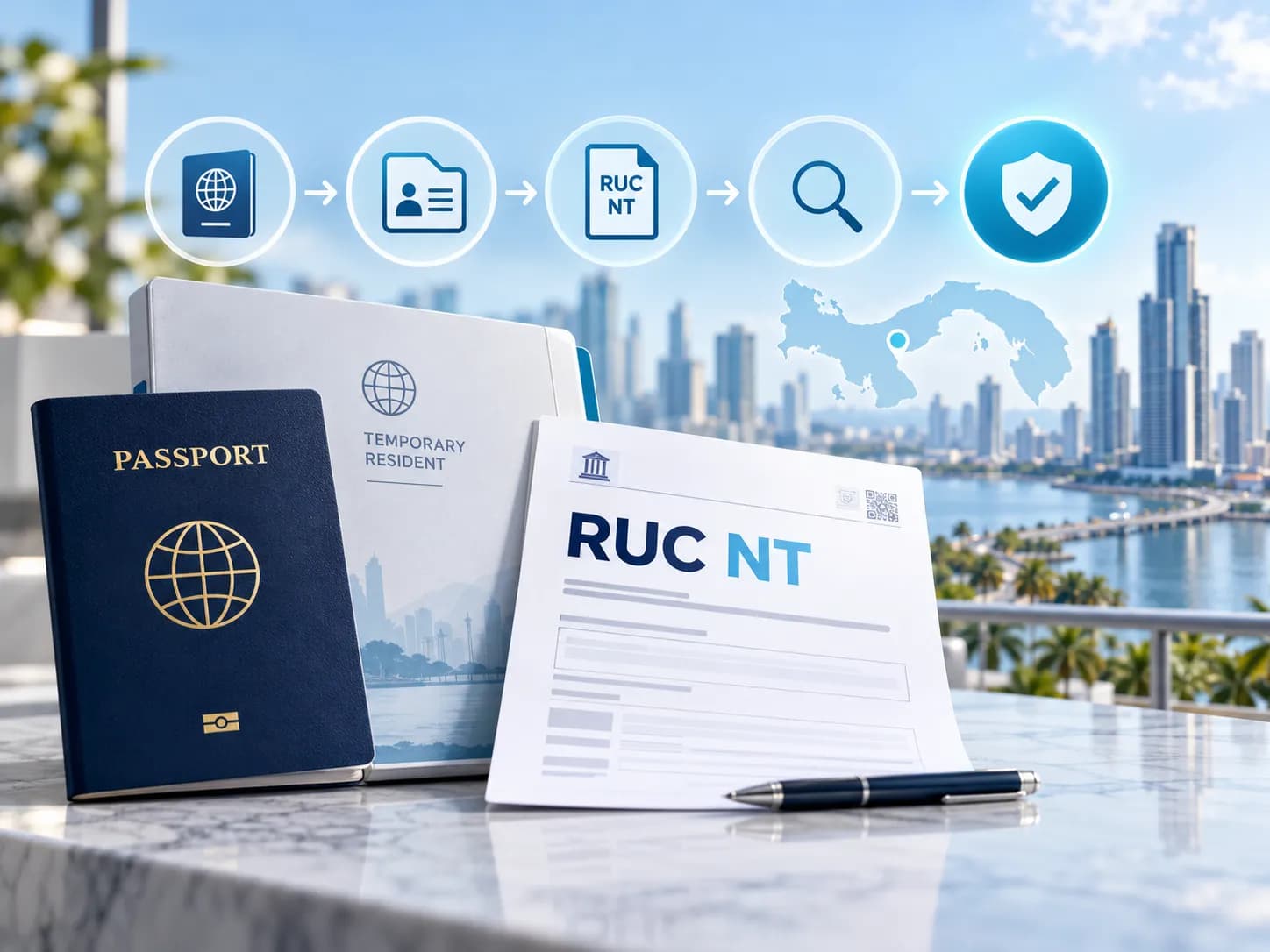
RUC vs NT in Panama: How to Choose the Right Tax Registration

Do I need a RUC, an NT or an NIT in Panama?
These three abbreviations are easily confused. You may be a Panamanian national starting an independent activity, a foreign resident without a Panamanian identity card, an overseas owner selling property, a purchaser of company shares or a director registering a company. The correct tax registration depends on who is being identified, why the identification is needed and which procedure the Dirección General de Ingresos (DGI) requires.
This guide is a navigation tool. It helps you recognize your situation and directs you to the matching CitizenResident service when one is available. It is not a substitute for checking the latest DGI requirements or obtaining a case-specific tax assessment.
What do RUC, NT, NIT and DV actually mean?
- RUC — Registro Único de Contribuyentes: Panama's taxpayer registration identifier. For an ordinary individual it is generally based on the Panamanian identity-card number; for a locally registered legal entity it is linked to its Public Registry inscription. Real estate also has a separate RUC de finca.
- NT — Número Tributario: a tax identification number assigned under specific DGI procedures, including to certain foreign individuals who do not meet the ordinary RUC registration conditions, foreign entities and some other entity types.
- NIT — Número de Identificación Tributaria: in Panama, this is the personal access password for e-Tax 2.0, rather than a replacement for the RUC or NT. The DGI describes it as an access credential that must be kept private.
- DV — Dígito Verificador: a verification digit associated with the registration and used in DGI transactions. It is neither the RUC nor the NIT password.
In other countries, “NIT” may be used as the main taxpayer number. Do not apply that meaning to Panama's e-Tax 2.0 system. See the DGI's official explanations of RUC, NIT and DV.
I am Panamanian or hold a Panamanian identity card. Which registration applies?
If you have a valid Panamanian cédula and qualify for ordinary individual registration, the starting point is generally your personal RUC, which is linked to that identity number. This can be relevant when beginning independent professional work, commerce or another activity that requires tax registration. Being a resident is not, by itself, proof that a particular tax obligation or registration route applies; the DGI classification and your actual circumstances control.
For an assisted registration, explore Personal Tax ID (RUC) for Permanent Residents and Nationals. This page explains the available professional-assistance packages; the DGI's underlying registration is a separate official process.
I am a foreigner and do not have the identification required for ordinary RUC registration. What should I request?
The DGI provides an NT procedure for certain foreign natural persons who cannot meet the ordinary RUC registration conditions because of their migratory or documentation situation. It lists foreign independent professionals, salaried individuals and other qualifying cases. The evidence required depends on the filing: the DGI may request a passport, immigration-movement certificate and proof of taxable activities or income.
Do not assume that every foreigner, temporary resident or person without a cédula automatically needs the same NT procedure. For example, a foreigner identifying themselves solely to sell property has a different DGI category from a foreigner performing professional services. If your purpose is personal tax identification in connection with your foreign-resident situation, start with Personal Tax ID (NT) for Temporary Residents, subject to eligibility confirmation.
The DGI separately describes NT registration for foreign individuals.
I live outside Panama and am buying shares in a Panamanian company. Why might I need a tax number?
The DGI has a dedicated NT registration route for a foreign natural person involved in the purchase of company shares. The tax ID may be necessary for the transaction and its related compliance process even though the buyer is not setting up a new Panamanian company or taking up local residence. The DGI identifies documents such as the buyer's identity, the seller's identity and a notarized share-purchase agreement for that category.
Start with Personal Tax ID for Company Share Purchases. This is a transaction-related personal identification service; it is not the same as registering the company's own RUC. Corporate buyers and unusual ownership structures may require another registration route or a separate review.
I am selling an apartment or land in Panama but live abroad. Which identification is needed?
A foreign natural-person seller may need an NT for the real-estate transaction if they do not already have the appropriate taxpayer registration. The DGI has a specific category for NT registration linked to the sale of an inmueble; its published list includes the seller's passport, the buyer's identity document and a signed, notarized sale agreement.
Explore Personal Tax ID for Real Estate Sales to see the specific registration-assistance options. The seller's personal NT and the property's own RUC are different records: one identifies the person for the transaction; the other identifies the finca for property-tax administration.
Does my apartment, house or parcel of land have its own RUC—even if I already have one?
Yes. Panama's DGI uses a separate RUC for a finca (real-estate property), made up of its finca number and location code, together with a verification digit for consultation. This record is used to access the property's tax account and related data. It does not make the property a person or replace the owner's own RUC/NT.
A person can therefore encounter several identifiers in the same matter: their own RUC or NT, the property's RUC de finca, the relevant DVs and NIT access credentials. A buyer or seller should confirm which record the DGI, bank, lawyer or closing professional is requesting rather than submitting one number for another. See the DGI's official RUC de finca explanation.
The finca record also involves cadastral and ownership information. The DGI indicates that property-value updates are handled with ANATI and reflected for property-tax calculation; that is different from applying for an NT as a foreign seller.
I am opening a Panamanian company. Does the company use my personal RUC or NT?
No. A Panamanian legal entity is identified separately for tax purposes. The DGI explains that its RUC is associated with the entity's Public Registry registration, while the representative's cédula or passport may be requested as part of the corporate enrolment. A foreign-incorporated entity or a special legal arrangement may instead fall under an NT category.
If you are still establishing the company, Panama Company Incorporation & Corporate Coordination provides context on the incorporation and coordination process. This is not a substitute for a dedicated corporate RUC registration quote, which may require an independent scope of work. Whether a company must register, update or activate its account, and which tax filings are then required, should be considered separately from the incorporation act itself.
Official background: DGI RUC registration and DGI list of e-Tax registration procedures.
Does a business need a second RUC at the municipality? And can a municipality itself have an NT?
Two different situations must be distinguished. First, a business operating in a district may have a municipal taxpayer or business record in addition to its national DGI registration. For example, the Municipality of Panama has procedures for updating a business's RUC in its municipal records and for other local taxpayer matters. This local registration is not automatically a new RUC issued by the DGI. Requirements depend on the municipality and the business activity; an Aviso de Operación may also be relevant.
Second, public-sector bodies may need their own DGI tax identification. The DGI has an NT procedure for entidades estatales, which is distinct from a commercial taxpayer registering a business with a municipality. Whether a specific municipality, agency or municipal legal entity uses that route depends on its legal status and the DGI classification; it should not be assumed that every municipal office automatically has an independent RUC or NT.
References: Municipality of Panama: RUC changes, Municipality of Panama: business procedures and DGI procedure for state entities.
What if my situation involves a condominium board, a trust, an NGO or another special entity?
The distinction between RUC and NT is not limited to individuals. The DGI publishes NT categories for certain property-horizontal boards of co-owners, trusts, foreign legal entities, public bodies and other organizations. Each has its own eligibility conditions and supporting documents. A property-horizontal entity's NT should not be confused with the RUC of an individual apartment, nor with the RUC of a management company.
CitizenResident does not currently present all these special registrations as separate products in the four personal RUC/NT variants described here. For these cases, use the DGI online-procedures list to identify the proper category before requesting a tailored quotation or engaging a qualified professional.
How do I apply for a RUC or NT through e-Tax 2.0?
The DGI generally processes the registration categories discussed in this guide through its e-Tax 2.0 platform. A practical sequence is:
- Identify the person or record: individual, foreign individual, Panamanian company, foreign company, special entity or finca.
- Select the correct DGI category: for instance, individual RUC, foreign-person NT, share-purchase NT or real-estate-sale NT. Do not choose the category only because its name resembles your immigration status.
- Prepare the documents appropriate to that category: identification, address and any evidence of taxable activity, migratory movement, notarized transaction or corporate registration required by the DGI.
- Submit the application through e-Tax 2.0: use the registration section, complete the relevant fields and upload the requested documents. Keep the application reference number.
- Monitor the registered email: the DGI may approve the registration or request correction. Once the account is ready, follow the instructions for setting up its NIT access credential where appropriate.
The exact screens, available routes and documentary requirements can change. Refer to the DGI RUC instructions, DGI foreign-individual NT categories and official NIT activation instructions. Some exceptions or corrective actions may require direct intervention, even if the standard initial registration is online.
After the registration is approved, how do I obtain the NIT?
The DGI's NIT is the password used with the relevant registration identifier to enter e-Tax 2.0. The DGI directs users to its NIT activation or recovery process, where the RUC, DV and registered email address are relevant. It states that the activation link must be used within two hours and that the credential must be changed every six months. Keep it confidential and control the associated email account; the NIT should not be shared casually with service providers.
See DGI — NIT: new and existing taxpayers for the current process. The NIT is an access credential, not a substitute for determining whether the taxpayer is properly registered or which obligations are open in the account.
Does the DGI charge for RUC or NT registration? What would a professional service fee cover?
The DGI describes the standard RUC and NT registration requests listed above as free official procedures. When CitizenResident displays a price for assistance, that price should be read as a professional or coordination fee, not a government charge for issuing the identifier. Additional costs may arise from notarization, translations, certificates or other third-party work, where applicable.
Compare the scope of each service, rather than selecting only the lowest displayed starting price. The appropriate personal RUC application, NT application for an individual, share-purchase NT and property-sale NT can involve different evidence, responsibilities and related procedures.
Which CitizenResident service should I explore for my specific situation?
| Your situation | Suggested starting point |
|---|---|
| I am a Panamanian national or eligible permanent resident seeking ordinary personal registration. | Personal RUC registration |
| I am a foreign individual who may need NT because ordinary RUC registration does not fit my documentation or status. | Personal NT for foreign / temporary residents |
| I am buying shares in a Panamanian company and require transaction-specific personal tax identification. | Personal tax ID for share purchases |
| I am selling Panamanian real estate and may require a personal NT for the transaction. | Personal tax ID for property sales |
| I am incorporating a company, handling a finca's own RUC, registering a PH/trust or dealing with a municipal or state entity. | Check the relevant DGI category first. Company incorporation coordination is relevant only if company formation is also part of your project. |
These routes are guidance, not an automatic eligibility determination. The underlying DGI procedure takes precedence over a commercial service label. Where the listed service does not cover your case, request a specific scope rather than assuming a package includes a different registration category.
What happens after I receive the RUC or NT?
A successful registration is only the first step in maintaining an accurate tax profile. Depending on your circumstances, you may later need to review registered economic activities, contact information, obligations, invoice arrangements, individual or corporate filings, municipal records and the treatment of a property or transaction. Obtaining an identifier does not, by itself, establish that every tax return is due—or that no filing is required.
Those are distinct questions from choosing the initial registration route. They should be addressed through jurisdiction-specific accounting and tax-compliance guidance, not loaded into a universal RUC/NT registration checklist.
Official sources and scope of this guide
Core official references: DGI — RUC, DGI — NT for foreign individuals, DGI — NIT access, DGI — RUC de finca, DGI — online procedure categories, and Municipality of Panama — municipal RUC record.
Reviewed: 4 November 2026. This is general information for identifying the appropriate registration path. It does not constitute tax or legal advice and does not guarantee approval. Requirements and classifications should be confirmed with the DGI and the applicable municipal or other authority before submitting documentation or making a payment.