Accounting & Tax
Understand when a buyer of Panamanian company shares needs an RUC or NT, the Form 108 withholding obligations and the difference between Basic and Premium assistance.
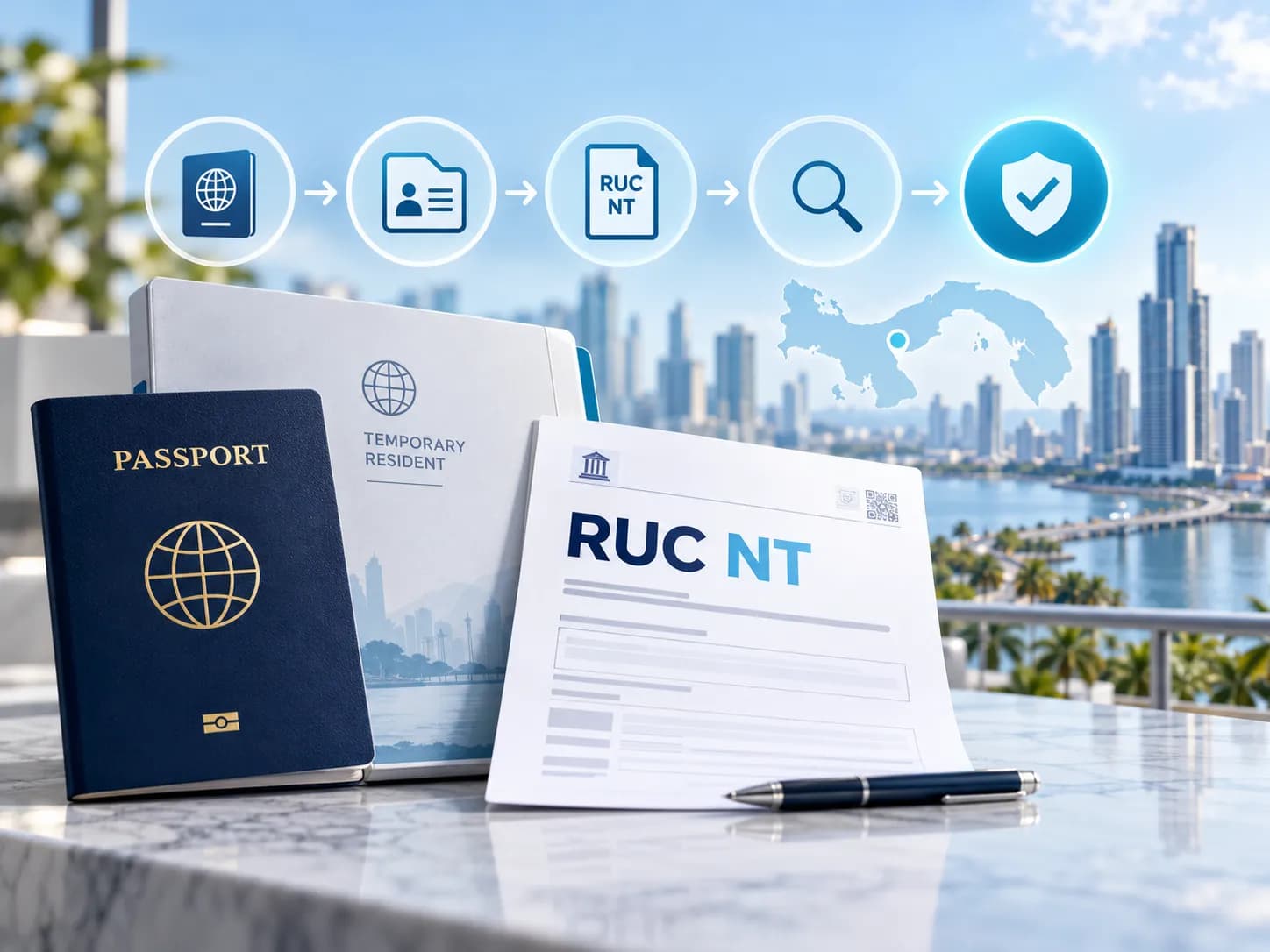
A foreign individual or company purchasing shares in a Panamanian corporation may need a taxpayer identification number (RUC or NT) before meeting applicable share-transfer reporting obligations. Panama’s Directorate General of Revenue (DGI) has dedicated NT registration procedures for foreign individual buyers and foreign legal entities. CitizenResident helps purchasers understand which registration applies, what documentation may be needed and how Basic or Premium assistance differs. A tax ID supports administration of the acquisition; it does not by itself transfer the shares, establish immigration or tax-resident status, or clear the target company of liabilities.
In a share sale subject to the ordinary Panamanian capital-gains withholding framework, the buyer is responsible for withholding and reporting the applicable tax through DGI Form 108. In the standard taxable case, the withholding is 5% of the gross sale consideration and the buyer must handle the corresponding DGI declaration and remittance when applicable. Special transactions and exemptions require individual analysis. The percentage is a transaction tax obligation, not a professional service fee or a charge for registering an NT.
An existing valid RUC or NT may already be sufficient. Before applying, the buyer should determine whether the purchaser named in the agreement is the individual personally, a Panamanian company or a foreign holding company. The identification issued to the company whose shares are being purchased is separate from the purchaser’s own taxpayer record. The NIT is the credential used to access the DGI e-Tax system, not a different type of share ownership.
A foreign natural person without a Panamanian tax registration may use the DGI’s foreign-individual share-purchase NT route. A foreign company purchasing the shares follows the foreign-legal-entity share-purchase NT route and must substantiate its existence and signatory authority. Applicants with an existing taxpayer number should first have that record checked; duplication can create avoidable administrative problems.
Purchasing newly issued shares in a capital increase, receiving shares by gift, or buying securities under a special regime should not be assumed to have the same documentary or withholding treatment as purchasing outstanding shares from another shareholder. Where the transaction is part of a broader investment or corporate restructuring, obtain independent legal and tax advice before selecting the filing approach.
The DGI’s specific NT procedures identify the buyer’s identification, seller identification and a notarized share-purchase agreement among the essential supporting documents. Foreign corporate purchasers face additional proof-of-incorporation and representation requirements. Depending on origin and language, apostille or legalization and certified Spanish translation may be required. These are conditional requirements, not a universal list for every buyer; the service’s requirements section explains the relevant document categories.
The purchase agreement and proper signatures often need to be arranged before the NT application can be completed. The registration process therefore depends on the transaction documents, but not every contract, certificate, representation check or legal closing activity is included automatically. Company-share acquisitions also require separate attention to the share register, ownership restrictions, beneficial ownership, financial records, liabilities and, when relevant, underlying real estate. Buying shares in a property-owning company is not the same as a direct real-estate purchase; a different registration route may apply when purchasing or selling real estate directly. See the tax-ID service for real-estate sales.
Choose Basic when the purchaser already has legal advisers and a notarized purchase agreement and needs focused help assessing, preparing and submitting the appropriate NT/RUC registration. Basic handles registration-related documentation and ordinary DGI application follow-up but does not arrange the notarization or prepare Form 108.
Choose Premium when a single engagement must also coordinate notarization of an already prepared share-purchase agreement, selected company-certification support, applicable Form 108 reporting, assistance coordinating the withholding payment and a dedicated case manager. Premium includes professional assistance with these defined components; it is not an unrestricted legal or financial due-diligence engagement.
| Service comparison | Basic | Premium |
|---|---|---|
| Buyer tax-registration review and NT/RUC application | Included | Included |
| Registration-specific document assessment | Included | Included |
| Notarization coordination for one prepared share-purchase agreement (notary fees separate) | Not included | Included |
| Selected corporate certificate support | Not included | Included |
| Applicable Form 108 share-transfer reporting | Not included | Included |
| Withholding-tax payment assistance | Not included | Included |
| Dedicated case coordination | Not included | Included |
CitizenResident helps connect the purchaser, transaction counsel, tax advisers, notaries and any necessary translators or corporate-service professionals. The responsible authorized professional handles each legal, notarial or tax filing activity. The portal coordinates the agreed dependencies and records; it does not replace legal advice or perform notarial acts itself.
Obtaining the purchaser’s NT/RUC is distinct from preparing the share-transfer tax declaration, funding the applicable withholding and completing corporate ownership formalities. The selected package defines which reporting and coordination services are included, while the buyer remains responsible for the underlying transaction obligations.
Drafting or negotiating the share-purchase contract, full corporate due diligence, title investigations, share-ledger changes, legal representation at closing, independent tax opinions and continuing compliance are outside the packages unless expressly quoted. Buyers inheriting an operating business may require separate accounting and bookkeeping support to evaluate records and future obligations.
The professional handover should explain the status of the buyer’s tax record, the agreed reporting deliverables and any remaining action for the transaction team. Issuance of an NT does not prove that Form 108 was filed or that the purchase has closed; those are separate outcomes. The selected package and the approved engagement determine responsibility for each. Buyers should coordinate outstanding closing responsibilities with the attorney, resident agent and accountant responsible for the transaction.
Our team is ready to assist you. Schedule a consultation to discuss your needs.
Contact Our TeamCommon questions answered before your consultation.
Not necessarily. The existing record should be checked for the exact purchasing person or company before another application is made. For a different activity-based registration scenario, see NT registration for temporary residents.
Not automatically. The DGI offers NT procedures for foreign individual and foreign corporate purchasers, independently of obtaining immigration residence. For the distinctions between RUC, NT and e-Tax NIT access, consult the Panama taxpayer-identification guide.
Taxpayer registration identifies the buyer for DGI purposes. When the ordinary share-transfer rules apply, the buyer must separately address Form 108 reporting and withholding on the transaction. The buyer’s statutory tax obligation is not discharged merely because an NT or RUC has been issued.
No. A subscription of newly issued shares may have a different legal and tax characterization. Confirm the transaction structure before assuming the ordinary sale-of-shares Form 108 process applies.
The foreign legal entity is the applicant and may need to provide legalized evidence of incorporation, representation and authorization, as well as the purchase agreement. The personal passport route alone is not a complete checklist.
No. A taxpayer number does not update the issuer’s share register, confirm ownership, clear liabilities or complete closing. The transaction lawyer and corporate recordkeeper handle those separate matters.
No. A share buyer should independently assess company assets, liabilities, tax compliance and contracts. The appropriate specialists may require separate tax-return assistance where a distinct filing obligation applies; an NT alone does not create an automatic annual return.
Schedule your initial consultation and let us guide you through the process. We respond within 1 business day.
Contact Our TeamPick the one that fits your situation