Accounting & Tax
Register a personal NT in Panama before receiving a cédula. Compare Basic DGI filing with Premium invoicing, bookkeeping and tax-return coordination.
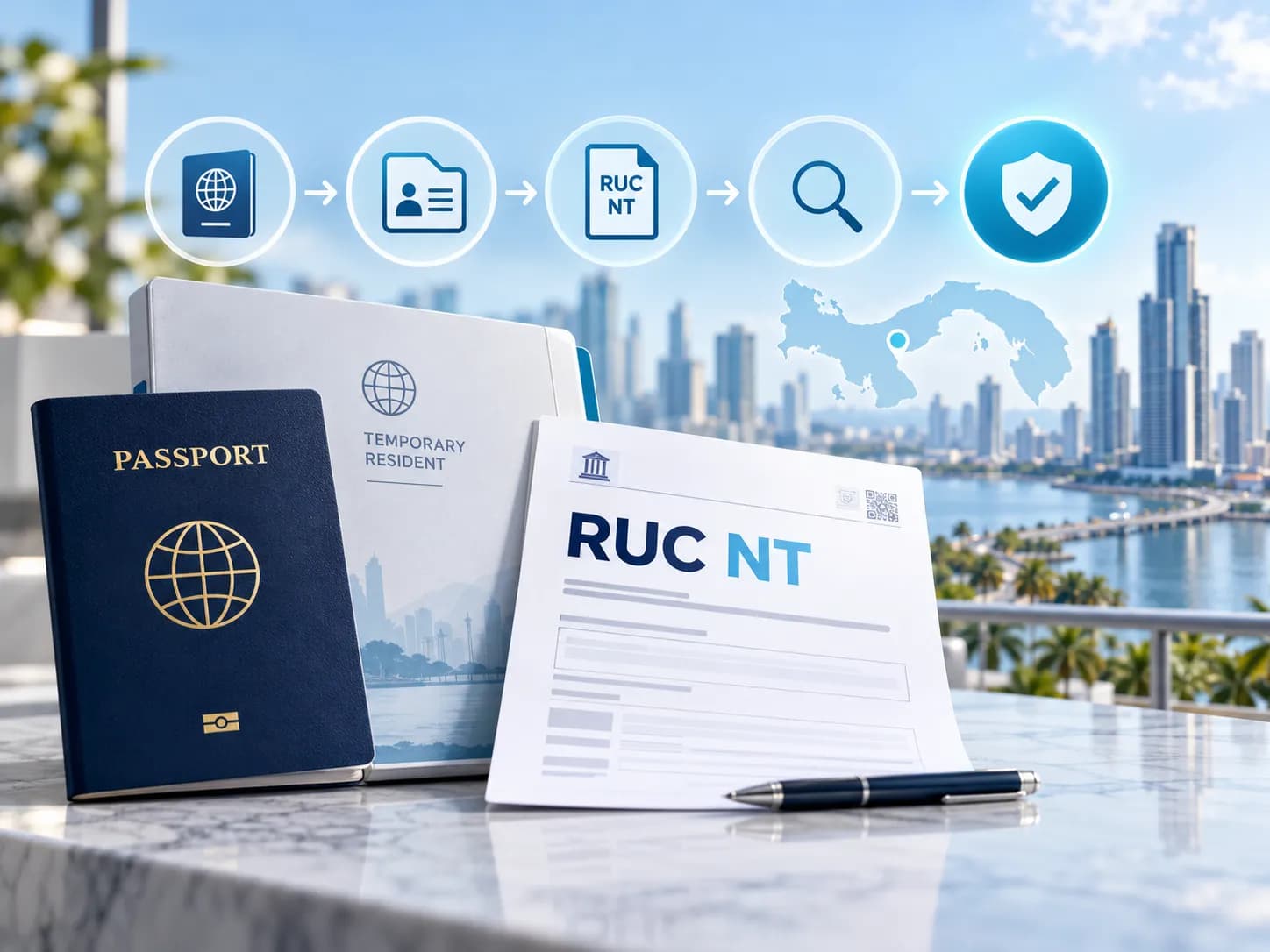
A Número Tributario (NT) is a Panamanian taxpayer identifier issued by the Dirección General de Ingresos (DGI) to certain foreigners who do not yet have a Panamanian identity card (cédula) and therefore cannot use a cédula-based personal RUC. This service focuses on temporary residents who need to identify and report income taxable in Panama from independent professional work or an eligible individual business activity. An NT is for tax administration; it does not grant immigration residence, a professional license or permission to work.
The appropriate registration depends on the actual income source and the person’s legal immigration and work-authorization position. A temporary resident expecting to invoice local clients may need an NT even before becoming eligible for a permanent-resident cédula. Income from salaries and other activities may require a different compliance review.
Under Panama’s fiscal-residence rule, spending more than 183 days, consecutive or nonconsecutive, in Panama during a fiscal year or the immediately preceding year is an important test. Immigration residence and tax residence are not interchangeable, however, and receiving an NT does not itself establish fiscal residence. The DGI also offers other NT routes that do not depend on this professional-services residency scenario.
Foreign professionals working in Panama for a shorter period may instead face payer-side withholding and/or other reporting obligations, depending on where services are performed, the nature of the payment, and any applicable tax treaty. Being below 183 days does not automatically make a payment tax-free or mean an NT can never be required. A separate tax consultation is advisable before the Panamanian hiring company applies withholding or the foreign professional begins invoicing.
For the independent-professional or locally taxable-income application, the DGI asks for an identifiable foreign applicant, a valid passport, a current official immigration-movement record and evidence of income earned or accrued that is subject to Panamanian tax. Uploadable supporting evidence can include issued invoices, a notarized services agreement or other contracts. Where those documents are unavailable, a certification of taxable income issued by a Panamanian Certified Public Accountant (CPA) can be used in the circumstances specified by the DGI. The taxpayer’s fiscal address and supporting documents must also be consistent.
The DGI registration itself is free of government application charges. Obtaining an immigration certificate, notarizing a contract, preparing CPA evidence or translating foreign-issued documents may involve separate professional or third-party charges.
For an individual business that requires an Aviso de Operación, the usual administrative dependency is to establish an eligible immigration position, arrange the DGI taxpayer registration, and then obtain the business notice through PanamaEmprende where applicable. The relevant MITRADEL work-permit category must also be assessed and obtained when required: neither the NT nor the business notice replaces a work permit. Timing and sequencing of the immigration, commercial and labor steps vary by category; engaging in work before authorization is not implied or permitted by registration.
Certain liberal professional services and other activities are exempt from a mandatory Aviso de Operación, although professional licensing, labor and tax obligations can still apply. A MICI certification of exemption may be relevant to some work-permit filings. This assessment is separate from NT registration.
A foreign individual may be able to apply for a Panamanian Certificate of Tax Residence using an NT even without a Panamanian cédula-based RUC. The certificate is a separate DGI review, not an automatic outcome of obtaining an NT. Official immigration movements and other evidence of residence and economic or personal ties are assessed, including any treaty context. It must be requested independently and is not included in either package.
After acquiring qualifying permanent-resident status, an individual normally obtains the relevant E-series cédula through Panama’s Tribunal Electoral and then asks the DGI to modify the NT registration to the cédula-based RUC. The change is intended to retain or reconcile the taxpayer’s existing e-Tax history—prior filings, payments, balances and obligations—but historical data should be checked after the DGI completes the migration.
The electronic-access NIT is not the NT itself: it is the private e-Tax access credential. After the RUC change, the taxpayer should confirm the registered email and activate or renew NIT access for the updated identifier. Modification can take several months, potentially approaching six months in complex cases. It is usually prudent to submit any imminent annual personal income-tax return before requesting the identifier change, where permitted, to minimize interruption to filing access.
Some individual NTs display a province-related leading digit, for example 8-NT or 2-NT. The actual full identifier must be confirmed on the DGI record rather than inferred from the prefix. Upon registration, the DGI system assigns the taxpayer a separate dígito verificador (DV). To check whether a person or company has an active taxpayer identifier, use e-Tax 2.0’s public Consultas → Consulta RUC Activos facility and search using the registered full name or business name.
The DGI also provides separate NT application routes for certain sales of Panamanian real estate and purchases of shares in companies. These are transaction-specific applications with different supporting documents and should not be confused with the recurring local-professional-income route described here.
CitizenResident organizes the NT application process across the taxpayer and relevant tax, accounting and immigration-document professionals. Where required, attorneys, certified translators or other specialists may handle specific supporting records. The relevant authorized professional prepares or submits the agreed work; CitizenResident supports cross-professional coordination rather than independently certifying tax status.
| Included service | Basic | Premium |
|---|---|---|
| Eligibility and tax-registration review | Included | Included |
| Personal NT application and DGI submission | Included | Included |
| Immigration-movement certificate coordination | Not included | Included |
| Electronic-invoicing enrollment (eligible DGI free plan, subject to applicable revenue limits) | Not included | Included |
| Bookkeeping and reconciliation | Not included | Up to 50 transactions/year |
| One annual personal income-tax return | Not included | Included |
| Dedicated Client Manager and multilingual updates | Not included | Included |
Tax consulting and withholding analysis; Panamanian tax-residency certificate; NT-to-RUC modification after issuance of a cédula; MITRADEL work permit; Aviso de Operación; municipal registration; ITBMS returns; payroll, CSS enrollment and monthly returns; CPA income certification when not already available; and PAC invoicing or bookkeeping beyond the defined limits are not automatically included in either package. They require a separate quotation where relevant.
Our team is ready to assist you. Schedule a consultation to discuss your needs.
Contact Our TeamCommon questions answered before your consultation.
Yes. DGI has a personal NT route for qualifying foreigners who do not yet have a cédula-based RUC. An NT is a tax identifier and does not authorize immigration residence or work.
More than 183 days in the relevant fiscal period is an important Panamanian tax-residence test, not a universal condition for every NT route. Registration depends on the taxable activity, documents and applicable DGI category.
The Panamanian payer may have withholding obligations, and the individual may face other tax or labor requirements. Treatment depends on source of income, the facts and any applicable treaty. Request separate tax consulting before relying on a nonresident assumption.
For a taxable professional-income application, the DGI generally requires evidence of taxable income, such as invoices or a notarized contract; a CPA income certification may be accepted when those records are unavailable.
No. Immigration permission, professional restrictions, an Aviso de Operación where mandatory, and the relevant MITRADEL work-permit rules must each be assessed separately.
An NT holder without a cédula may be eligible to apply. DGI evaluates actual residence and documentary evidence separately, and issuance is not guaranteed by the NT.
You can request the DGI change from NT to cédula-based RUC, then reactivate the appropriate NIT access. Check historic filings and payments after migration and avoid filing deadlines during an ongoing change.
Use DGI e-Tax 2.0, Consultas → Consulta RUC Activos, searching by the registered full name or entity name. The DGI assigns the verification digit (DV) separately from the private login credential (NIT).
Yes. The DGI identifies separate NT routes for selling Panamanian real estate or buying company shares. Those routes have transaction-specific requirements and are not the temporary-resident professional-income package.
The Basic NT-registration package covers professional review and submission of the DGI registration. Official NT application is free; extra evidence or administrative services may be separately quoted.
The Premium NT-registration package adds coordinated immigration-movement evidence, eligible invoicing setup, defined bookkeeping, one personal annual tax return and dedicated client management.
Schedule your initial consultation and let us guide you through the process. We respond within 1 business day.
Contact Our TeamPick the one that fits your situation