
Accounting & Tax
Focused professional RUC/NT registration support for individuals and companies selling property in Panama, including verification of existing taxpayer records.
When preparing to sell real estate in Panama, the property itself and the person or company selling it are not the same taxpayer record. Your finca may have its own property-tax information, while the seller must be correctly identified with Panama’s Directorate General of Revenue (DGI) for the relevant transaction declarations. This distinction can be overlooked until a lawyer or accountant needs to work with the seller’s tax profile.
Our Basic package concentrates on that specific issue. It is designed for a property owner who has a reasonably organised sale and wants a professional to assess the applicable RUC or Tax Number (NT) route, attend to a standard registration or routine profile update, and communicate the result to the people handling the sale. It provides a clear area of professional responsibility without turning a limited administrative need into an unnecessarily broad engagement.
A foreign individual selling an apartment, a Panamanian resident selling a personally owned home, and a company transferring an asset may all face different taxpayer-registration circumstances. The relevant question is not simply whether the person contacting us has a Panamanian cédula. It is who appears as the registered seller, whether that seller already has a usable tax record, and whether the record is appropriate for the intended transaction.
For example, a nonresident foreign owner may need the DGI’s dedicated NT route for a property sale, while an established Panamanian company may already have an RUC that should be verified rather than duplicated. A shareholder’s personal tax number cannot be substituted for the company’s registration when the company is the legal owner. Recognising these distinctions early helps reduce avoidable confusion between the property records, the proposed agreement and the taxpayer named in the sale.
Tax identification often receives less attention than marketing the property, negotiating the price or arranging the purchase-and-sale agreement. That can create an unwelcome administrative dependency when the transaction moves closer to closing. Differences in an owner’s name, identification details, company representation or existing DGI profile may require clarification before the tax-registration matter can be concluded.
Basic helps give this issue a clear owner. Rather than leaving the client to determine which type of registration to request, the engagement focuses on the taxpayer information and supporting records relevant to a standard case, with ordinary follow-up on the submission and clear communication of the outcome. If a separate legal, notarial or historic tax problem appears, it can be identified without implying that its resolution was included in the original service.
This option can be particularly practical for an owner who lives outside Panama and has already appointed a conveyancing lawyer, or for a corporate seller whose authorised representatives and transaction documents are substantially in order. You may not need a new number at all: confirming that an existing RUC or NT is appropriate can be just as important as requesting a new registration. The value lies in directing the administrative work toward the correct taxpayer rather than pursuing an unnecessary application.
Basic also supports continuity between professionals. Your lawyer remains responsible for the legal transfer, while the accountant preparing the sale-related tax declarations can use the confirmed seller registration in the work they are separately engaged to perform. The result is a more defined handover and fewer assumptions about who is handling which aspect of the transaction.
Obtaining or updating a tax identifier does not establish ownership, confirm the property is free of debts, grant immigration or tax-resident status, or settle the taxes triggered by a sale. Basic is not a title investigation or an assessment of the correct capital-gains tax, transfer-tax treatment or available exemptions. Forms 106 and 107, property-tax clearances, contract drafting, notarial work and conveyancing remain separate matters for the appropriate professionals.
Choose Basic when the property sale is reasonably straightforward, the purchase-and-sale documentation and any notarial arrangements are being handled by your existing advisers, and you want targeted assistance with the DGI registration component. If you would also benefit from coordinated notarization, supporting certifications, preliminary document-risk screening and a dedicated point of contact, consider our Premium property-sale tax registration package.
Our team is ready to assist you. Schedule a consultation to discuss your needs.
Contact Our TeamCommon questions answered before your consultation.
Basic is intended for an individual or company with a reasonably organised property sale and existing legal advisers handling the agreement and closing. It focuses on the DGI tax-registration component, rather than providing a complete property-transfer service.
The finca identifies the property for registry and property-tax purposes, whereas the RUC or NT identifies the person or company selling it. They are not interchangeable. The seller’s registration is relevant when the tax professionals handle the declarations associated with the transfer. See why the legal identity of the seller matters.
Not necessarily. The correct approach may be to confirm an existing RUC/NT or arrange a routine update, rather than request another number. Individual taxpayers with a Panamanian cédula can also review the separate personal RUC registration service to understand the distinction between registration categories.
No. The Basic option assumes that the appropriate legal professionals arrange the agreement and any required notarisation. Where these dependencies need professional coordination, Premium provides broader support, while legal drafting and notarial charges remain separate.
Yes, subject to the appropriate taxpayer category, complete supporting records and any valid authorisation required for representation. Living outside Panama does not by itself require the seller to become a Panamanian immigration resident. Certain documents may nevertheless need notarisation, authentication or other formalities.
Yes, for a standard registration matter after confirming the company is the legal seller and its representative is authorised to act. Foreign-entity documentation and complex shareholder, trust or multi-owner structures may require additional review or a separate quotation.
Ordinary questions concerning the registration submission are within the defined follow-up. Extensive reconstruction of historic records, outstanding tax liabilities, disputes or complex corrective procedures are different services. We explain such issues when identified rather than assuming they are included.
No. The service does not calculate or file the sale taxes, obtain the finca’s paz y salvo, draft the sale agreement or complete the Public Registry transfer. For a wider transaction requiring coordination among legal and other providers, see our separate real estate coordination service.
No. An RUC or NT identifies the taxpayer for DGI purposes; it is not a residence permit or, by itself, proof of tax residence. Tax residence is determined under separate legal criteria.
Schedule your initial consultation and let us guide you through the process. We respond within 1 business day.
Contact Our TeamRequirements
An indicative list. The final list depends on your case and is confirmed in the first consultation.
Showing the requirements for: Applicant. Not in your case: Company.
Before selecting a DGI registration route, confirm who appears as the registered owner of the property (individual or company), whether that taxpayer already has a usable RUC/NT, and the intended sale. Co-owners, trusts or other ownership structures require an individual assessment outside the standard one-seller scope.
Foreign corporate certificates, powers and other records must meet Panama’s document formalities. Depending on the DGI route, apostille or consular legalization and certified Spanish translation may apply. We identify the relevant formalities before requesting originals.
Provide a clear copy of the individual seller's valid passport or Panamanian cédula, as applicable. For a foreign individual's property-sale NT application, also identify the buyer with a valid cédula or passport. For a corporate seller, the authorized representative must supply identification under the corporate-document requirements.
For a foreign individual requesting an NT specifically for a property sale, DGI requires a purchase-and-sale agreement signed by buyer and seller and notarized. An unsigned offer or listing is insufficient. A company or an existing RUC holder may follow a different registration route.
Provide the property's finca/folio number, location and available deed, registry certificate or property-tax reference. These identify the asset and help reconcile the transaction with the seller's records. The property's tax identifier is not the seller's RUC/NT; complete title due diligence and property-tax clearance are separate services.
Disclose any RUC or NT already assigned to the seller, prior DGI registration, e-Tax 2.0 profile and current tax domicile/contact details. Existing records should be verified before requesting a new registration. Access and representation are handled through secure, authorized channels; do not send your NIT password by ordinary email.
If a company owns the property, provide documents showing its incorporation, current legal existence and the authority of its legal representative, including resolutions or powers when relevant. Foreign-company certificates may require apostille or legalization and Spanish translation. The exact evidence depends on the taxpayer and DGI route.
Provide a signed authorization or power covering the agreed DGI registration. A company signatory must have authority to represent the seller; notarization or authentication may be required.
For your case
Estimated total
From USD 500
1 person: Applicant · See the breakdown
The checklist and the costs on this page follow this composition.
From USD 500per case
Fees charged for the seller's RUC/NT registration or routine profile update for one seller, one identified property and one intended sale. Additional owners, properties, complex structures and historical corrections require a separate quotation.
DGI does not charge an official fee for ordinary RUC/NT registration. Public charges for other documents or taxes related to the sale, if applicable, are assessed separately.
Official fees may change; we confirm the budget in the first consultation.
We confirm the seller, buyer, finca, existing DGI registration, availability of the sale agreement and whether the case falls within the standard scope. Missing records or unusual ownership structures may extend preparation.
We check that the seller's name or company details, identification, buyer information and finca references are consistent across the supplied documents. Routine omissions or discrepancies are flagged for correction before filing and may extend preparation. Contract drafting, legalization and rectification of historical tax liabilities are outside this registration scope.
We prepare and submit the applicable RUC/NT registration for the identified seller or coordinate a routine update of an existing taxpayer profile where appropriate. The submission uses authorized DGI/e-Tax channels. Registration does not confer immigration or tax residency and does not, by itself, settle the taxes due on the sale.
After submitting the request, we monitor routine DGI notifications and address ordinary requests for clarification within the agreed registration scope. Documentary requests and system issues can extend processing.
On completion, we provide available filing or registration confirmation, identify the RUC/NT or profile update achieved, and summarize unresolved items for the client or closing advisers. This handover does not include preparing Forms 106/107, paying transaction taxes, obtaining the finca's paz y salvo or completing the transfer deed.
Missing a document, or not sure it applies to your case?Let's go through it together in a consultation

Check whether you need a personal RUC and compare Basic registration with Premium support, including up to 50 bookkeeping transactions per year.
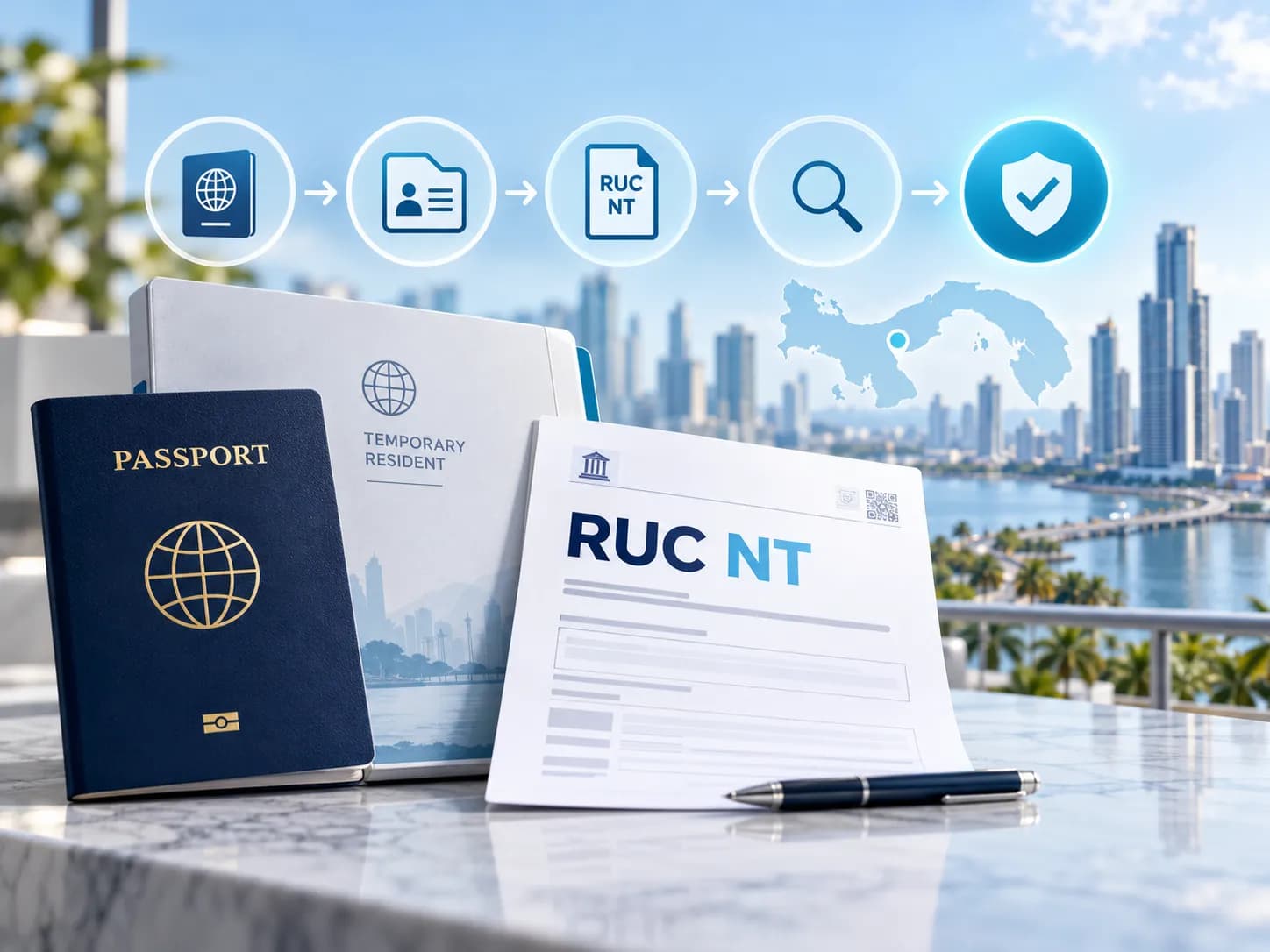
Temporary-resident NT registration for locally taxable professional or business income, with Basic and Premium assistance.

A practical guide to personal tax returns in Panama, including salary-only cases, independent income, deductions, linked obligations and service options.

Corporate income tax filing in Panama explained: annual reporting, revenue and expense records, no-activity companies, ITBMS, payroll and municipality.

A strategic real estate coordination service for international clients who want to search, evaluate, acquire, structure, maintain or administer property in Panama, including coordination with brokers, lawyers, immigration attorneys, CPAs, banks, tax professionals, corporate providers, property managers and government authorities.

Panama's property market now requires more than comparing locations and prices. New transfer-tax incentives, a proposed change to PH expenses, residency thresholds and ownership structures can produce very different outcomes for personal buyers and investors.