Electronic Invoicing Is Not Bookkeeping: Why Panama Businesses Must Reconcile Invoices, Collections and Accounting Records
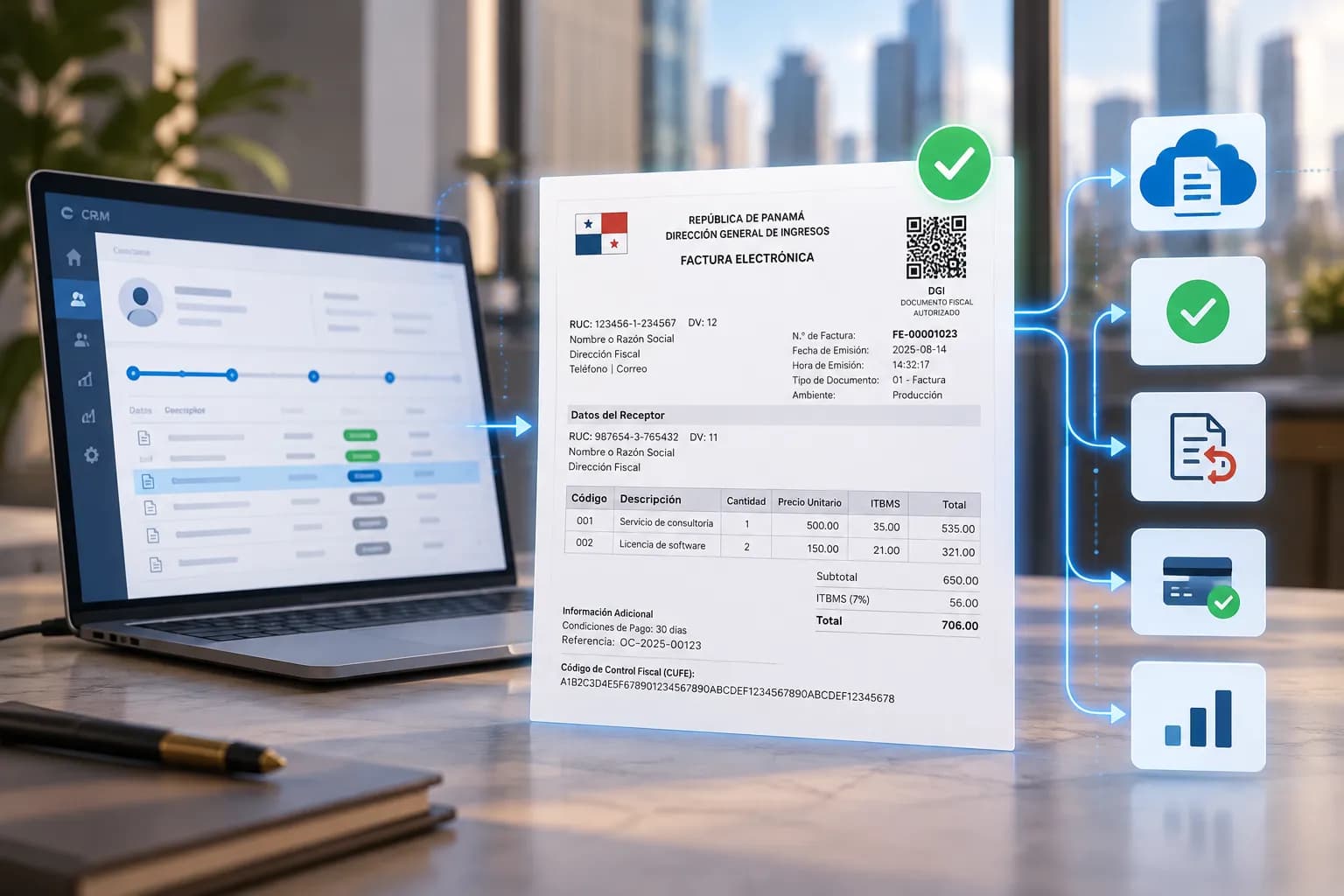
Electronic invoicing is an important compliance step—but it is not bookkeeping.
For a Panama business, issuing an authorized invoice answers one important question: was the sale or service properly documented through the applicable invoicing method? Bookkeeping answers a much broader set of questions. Was the invoice recorded as revenue or another type of transaction? Is the amount still collectible? Was a credit note later issued? Did the client pay? Did the payment reach the bank? Were bank fees or withholding deducted? Does the general ledger agree with the invoicing record, and can those figures ultimately support financial statements and tax reporting?
That is why a company can have a functioning electronic invoicing system and still have weak accounting. The financial trail normally extends well beyond issuance:
invoice → credit note, debit note or cancellation → collection → bank or payment processor → general ledger → reconciliation → financial statements and tax reporting.
Each stage has a different purpose. The real control comes from being able to follow a material transaction through the entire chain and explain any difference between the systems.
Who actually has to use electronic invoicing in Panama?
Panama's invoicing rules should not be described as if every taxpayer were in exactly the same position. Law 256 of 2021 expanded the invoicing framework, while subsequent regulations, administrative resolutions and a 2024 Supreme Court decision created important distinctions.
On 17 July 2024, Panama's Supreme Court of Justice declared unconstitutional the provision that imposed the use of fiscal equipment or the Panama Electronic Invoicing System (SFEP) on services performed in the exercise of liberal, artisanal and artistic professions, independently or through civil partnerships. The decision did not eliminate the general obligation to document commercial and service transactions, and it should not be generalized to every company that happens to provide a professional service.
The DGI later issued Resolution No. 201-7826 of 14 November 2024, repealing Resolution No. 201-7263. The DGI expressly recognized the Supreme Court exception while also stating that the obligation of the affected professionals to issue an invoice or equivalent document through another permitted method continues in force. In other words, the exception concerns the mandatory use of fiscal equipment or SFEP; it is not a general exemption from documenting income.
For businesses outside that specific exception, the applicable authorized invoicing rules continue to matter. Electronic invoicing is particularly relevant in dealings with the public sector: DGI regulations include Resolution No. 201-5215 of 19 July 2022 concerning the requirement for public entities to accept electronic invoices as the valid document for State purchases, and the MEF subsequently confirmed the electronic-invoicing requirement for State suppliers from October 2023.
The correct invoicing method therefore depends on the taxpayer, legal form, activity and transaction. A professional operating personally, a civil partnership, an operating corporation, a retailer and a company supplying the State should not automatically be treated as the same case.
The DGI also offers a free electronic invoicing option
Businesses that adopt the Panama Electronic Invoicing System do not necessarily need a paid PAC integration from the first day. The DGI provides the Facturador Gratuito, a free option accessible through the DGI/SFEP environment for taxpayers whose operating needs fit that model.
Under DGI Resolution No. 201-6299 of 29 July 2025, effective 1 January 2026, the current parameters for the Facturador Gratuito are up to B/.36,000 in annual gross income and up to 100 electronic documents per month for natural persons and legal entities. Taxpayers that exceed the monthly document limit or report annual gross income from B/.36,001 onward must use the PAC modality. Government entities that need to join SFEP may use the Facturador Gratuito without the same monthly document limit.
For a relatively simple or lower-volume activity, the free invoicer can therefore be an efficient way to issue authorized electronic documents without implementing a more complex billing platform. The trade-off is operational: the DGI states that the Facturador Gratuito does not permit integration with other systems. A company that wants automated CRM-to-invoice workflows, higher transaction volumes, payment synchronization or deeper system integration may need to evaluate a PAC-based architecture.
The choice between the free DGI tool and a more integrated solution should be driven by the business process—not by the idea that more software automatically creates better compliance.
An invoice is not a collection
A business can issue an invoice today and collect it tomorrow, next month or never. If the invoice is issued on credit, the accounting may need to recognize a customer receivable until payment occurs. Partial payments, discounts, disputed balances, credit notes and cancellations can all change what the customer actually owes.
This distinction matters operationally because an invoicing dashboard may show the amount billed while the accounting system should separately show what has been collected, what remains outstanding and what has been adjusted. If every invoice is treated as if it were cash already received, both cash-flow reporting and customer balances can become misleading.
A collection is not automatically a correct accounting entry
When money reaches a bank account, the deposit still has to be identified. One transfer may settle one invoice, several invoices or only part of an invoice. It may instead represent a customer advance, shareholder contribution, intercompany transfer, loan, reimbursement or another transaction that should not be recorded as ordinary revenue.
The bank proves that cash moved. It does not determine the accounting classification. That classification should be supported by the invoice, contract, payment reference and other relevant evidence.
Credit notes, debit notes and cancellations must flow into the books
The original invoice is only one part of the fiscal-document lifecycle. If a credit note reduces an invoice in the invoicing system but the accounting ledger continues to carry the original amount, revenue and accounts receivable can be overstated. If a cancellation occurs but the ledger is not updated, the invoicing record and accounting record begin telling different stories.
A reliable monthly process therefore captures the original invoice and the events that modify it. This becomes increasingly important when billing is handled by one team and bookkeeping by another.
The bank and payment processor provide a second source of evidence
Collections recorded against customers should ultimately be traceable to bank statements, card processors or other payment channels where applicable. Differences may be legitimate—for example processing fees, chargebacks, payment timing, withholding, bundled settlements or foreign-exchange effects—but they should be identified rather than carried forward unexplained.
Reconciliation is the process that converts those differences from uncertainty into documented explanations.
The general ledger is where the complete financial picture should come together
The accounting ledger organizes transactions into assets, liabilities, equity, income and costs or expenses through double-entry bookkeeping. It connects individual invoices and payments with the company's wider financial position.
Without a reliable ledger, a business cannot properly reconcile customer balances, cash, taxes and other accounts. It also becomes difficult to prepare dependable financial statements or an annual income tax return because the reporting process is being asked to compensate for accounting work that was never completed.
This is the same reason our Bookkeeping in Panama service treats transaction recording and reconciliation as connected functions: a sales invoice is a source document, while bookkeeping is the process that places that document inside a complete and traceable financial record.
Why invoicing and bookkeeping often diverge
The problem is frequently operational rather than technical. Sales may work in a CRM, billing may use the DGI free invoicer or a PAC, payments may arrive through several channels and accounting may receive the information only after the month has ended. Every manual handoff creates another place where a document can be omitted, duplicated or matched incorrectly.
Invoices are generated in one system while collections are tracked somewhere else.
Credit notes or cancellations never reach accounting.
Customer payments cannot be matched reliably to invoices.
Bank transactions are imported without useful customer or invoice references.
The CRM contains the commercial agreement but is disconnected from invoicing.
Spreadsheets become an informal bridge between billing and the ledger.
The accounting team receives information only at month-end or year-end.
A more mature workflow does not necessarily eliminate manual review. It makes ownership clear and ensures that exceptions are visible before they become year-end problems.
CRM, invoicing and accounting perform different jobs
A CRM can contain valuable commercial information: who the customer is, what was sold, the agreed price, contract status, payment schedule and responsible account manager. An authorized invoicing system converts the relevant commercial transaction into the required fiscal document. The accounting platform records the financial consequences and remains the system of record for the ledger and reconciliations.
Those systems can exchange information without becoming interchangeable. A well-designed integration can reduce duplicate data entry, but the CRM should not become the general ledger and a PAC authorization should not be treated as proof that the accounting has been completed.
What should a Panama business reconcile each month?
The exact control depends on the activity, but an operating business will often benefit from comparing the complete sales cycle rather than reviewing one report in isolation. This may include electronic invoices issued, credit and debit notes, cancellations, customer collections, payment-processor settlements, bank receipts, accounts receivable, revenue accounts and applicable ITBMS or other tax balances.
The objective is not to force all systems to display an identical number at every moment. Timing and accounting treatment can create legitimate differences. The objective is to understand why the differences exist and prevent unexplained items from accumulating.
When the invoicing problem is really a legal or commercial-structure problem
Not every discrepancy can be fixed by the accounting team. The contract may identify a different legal entity from the one issuing the invoice. A company may be billing for an activity that does not match its registered or licensed business. Related entities may share costs without written agreements. The customer may pay one entity while another is shown as the supplier.
Those situations can require corporate, contractual or regulatory review before the billing and accounting workflow is standardized. Automating an inconsistent legal structure only makes the inconsistency move faster.
For international or holding structures, invoicing should also be considered within the broader record-keeping and governance picture. Our article Why a Panama Resident Agent May No Longer Be Enough for Holding Companies examines how accounting evidence, corporate governance and operating substance can intersect for certain structures.
Electronic invoicing should make bookkeeping easier—not replace it
When the systems are designed well, electronic invoicing provides structured fiscal data that can improve accounting. Authorized documents can be matched to receivables, collections can be associated with the correct customer, bank transactions can be reconciled and management can see more clearly what has been billed, collected and left outstanding.
But that benefit only appears when the business maintains the connection between its commercial, invoicing, banking and accounting records.
The useful test is not simply “Did we issue the invoice?” It is “Can we follow this transaction from the commercial agreement through the fiscal document, collection, bank movement and final accounting treatment?”
If the answer is no, the next step may be recurring bookkeeping, accounting cleanup, e-invoicing setup, CRM/accounting integration or a review of the underlying corporate and commercial structure.
Regulatory framework referenced
This article reflects Panama's invoicing framework including Law 256 of 2021; the Supreme Court of Justice decision of 17 July 2024 published in Official Gazette No. 30130-A; DGI Resolution No. 201-7826 of 14 November 2024; Resolution No. 201-5215 of 19 July 2022 concerning State purchases; and DGI Resolution No. 201-6299 of 29 July 2025 updating duties of users of the Panama Electronic Invoicing System. Application depends on the taxpayer, legal form, activity and facts.