
Accounting & Tax
Expanded group reporting with appropriate CPA comments, professional signing and coordination for unaudited consolidated accounts.
The Premium consolidation package includes the core two-entity consolidation available in Basic and adds CPA explanatory comments, a professional signature where permitted, and a managed coordination layer. It is for situations in which the group report will be discussed with stakeholders who need help understanding its assumptions, or in which the managers of the participating entities are not in one place. The professional reporting outcome remains unaudited unless an independent audit has been separately commissioned.
The benefit is not that an accountant signs a document and transforms it into an audit. It is that the consolidation entries, underlying records, limits of preparation and reporting purpose can be communicated more consistently. In Panama, the legal and professional status of a CPA signature depends on the type of work and the applicable rules. The accountant should accurately state whether the engagement is preparation, compilation, another form of professional report or an independent assurance assignment.
Two otherwise well-run entities can have different chart-of-account structures, accounting policies, reporting dates or currencies. One may record a purchase as inventory while the other has classified the matching sale as revenue. An internal transfer of property or inventory can contain a profit that has not yet been earned from an unrelated customer. Without proper explanation, management may incorrectly treat the group’s reported profit as new external value.
The enhanced arrangement supports a more documented discussion of those issues. Management still owns the source records and retains responsibility for the representations and underlying accounting facts. A dedicated coordinator can facilitate information exchange among entities and professionals, but cannot act as the auditor, certify unsupported evidence or override a CPA’s independent professional judgment.
Suppose one company sells inventory to another group entity for USD 20,000, when the selling company originally paid USD 15,000. The intragroup seller recorded USD 5,000 in profit. If the purchaser still holds all the inventory at the reporting date, that profit has not been earned from an outside customer and an appropriate consolidation adjustment removes it under the applicable framework. The simplified table below illustrates the adjustment; tax treatment and indirect taxes require separate analysis.
| Calculation item | Amount |
|---|---|
| Internal inventory transfer (goods sold to a group entity) | $20,000 |
| Original cost to selling entity (cost before internal margin) | $15,000 |
| Internal profit (not yet realized from an outside customer) | $5,000 |
| Consolidation profit adjustment (if all goods remain unsold) | −$5,000 |
If only part of the inventory remains unsold, the calculation is different. If a third-party customer has purchased the goods, profit is recognized according to the applicable accounting rules. A competent preparer must trace the position to inventory records and distinguish an ordinary internal transfer from a sale that genuinely creates external group revenue. Adding a signature to the wrong adjustment would not make it correct.
A financial institution assessing a group company may ask for consolidated statements to understand the overall business, but it may also require a separate financial position for the borrowing or account-holding legal entity. Banks normally conduct their own review of beneficial ownership, economic activity and origin of funds. Financial statement preparation and corporate account opening are complementary functions; neither guarantees the other’s acceptance.
If a bank’s checklist or financing agreement expressly requires audited consolidated accounts, unaudited Premium statements do not meet that criterion simply because a CPA signs them. A separate independent audit engagement is needed. It is therefore practical to confirm whether the recipient needs a CPA-prepared presentation, a formal review conclusion or a reasonable-assurance audit opinion before selecting the reporting scope.
The group’s accounting eliminations do not automatically eliminate the individual entities’ legal tax obligations. Each taxpayer may require its own corporate income-tax return based on applicable Panamanian rules. A group might also need analysis of related-party transactions, documentation of services across borders and reconciliation of accounting figures to tax bases. Those matters are tax work, not inevitable components of a CPA-signed consolidation.
When the source accounts are inconsistent, additional bookkeeping or historical reconciliation may be needed for one entity before a meaningful group set can be issued. The Premium package does not silently absorb unlimited catch-up work, new entities, valuation services or an independent audit. Separating responsibilities gives the client a clearer report and reduces the risk of confusing reporting, tax and assurance concepts.
The proper result is a defensible group presentation that explains the reporting boundary, important elimination entries and any material limitations. Where justified, the CPA’s comments and signature identify the scope of professional involvement, while dedicated coordination supports communication and delivery. This gives management a document useful for decision-making without presenting it as an audit that has not taken place.
Our team is ready to assist you. Schedule a consultation to discuss your needs.
Contact Our TeamCommon questions answered before your consultation.
No. CPA comments and signature are not a substitute for an independent audit opinion.
It may explain material eliminations, reporting assumptions and accounting-policy decisions consistent with the agreed professional engagement.
Yes. The borrower’s own balance sheet and the wider group’s position answer different questions; the recipient decides what it needs.
No. Each entity’s fiscal duties must be assessed independently of accounting consolidation.
Specialist valuation and a larger reporting perimeter require explicit scope review; the defined package concerns the agreed group entities.
Corresponding ledgers, intercompany agreements, transaction support and reconciliation evidence are central to defensible reporting.
Yes. Standalone CPA statement preparation can support each legal entity, while the consolidated report gives the group perspective.
Schedule your initial consultation and let us guide you through the process. We respond within 1 business day.
Contact Our TeamRequirements
An indicative list. The final list depends on your case and is confirmed in the first consultation.
Showing the requirements for: Company. Not in your case: Foundation and Trust.
Identify the parent, entities in scope, controlling relationships, ownership documents, operating activities, reporting dates and currencies. Common ownership alone may not constitute IFRS 10 control.
Provide available prior-year statements and comparatives, including the reporting basis and important changes; absence of prior reports may require additional work.
Provide group-company contracts, internal loans, related-party sales, reciprocal balances and supporting confirmations needed to justify consolidation eliminations.
Authorized management must review, explain and approve the source information, material assumptions, adjustments and final reporting figures; CPA signing is not an audit opinion.
Explain relevant recognition, valuation, depreciation, currency and disclosure policies; any changes or complex judgment areas require supporting records.
For your case
Estimated total
From USD 2,200
Your case: Company · See the breakdown
The checklist and the costs on this page follow this composition.
From USD 2,200per case
Fees charged for services included in Basic Package + Premium CPA explanatory support, eligible signature and dedicated coordination. From USD 2,200 per agreed reporting-period set; applicable ITBMS, if chargeable, is additional. Extra entities or historical reconstruction are separately assessed.
Independent audit, valuation, apostille, authorized translation, specialist legal work and bank onboarding support are separately scoped third-party services when required.
Official fees may change; we confirm the budget in the first consultation.
Confirm recipient, entity and reporting period, intended accounting framework and whether CPA preparation, signature or independent audit is actually required.
Prepare period-end accounting information or consolidation entries after reviewing the completeness and consistency of underlying source records; timing depends on client evidence.
CPA professional review and eligible signing within the agreed engagement. A signed prepared statement does not constitute an independently audited report.
Dedicated coordination of group reporting questions, professional handover and communications where included in Premium; specialist execution remains separate.
Missing a document, or not sure it applies to your case?Let's go through it together in a consultation

Understand preparation, reporting scope and the difference from audited accounts.
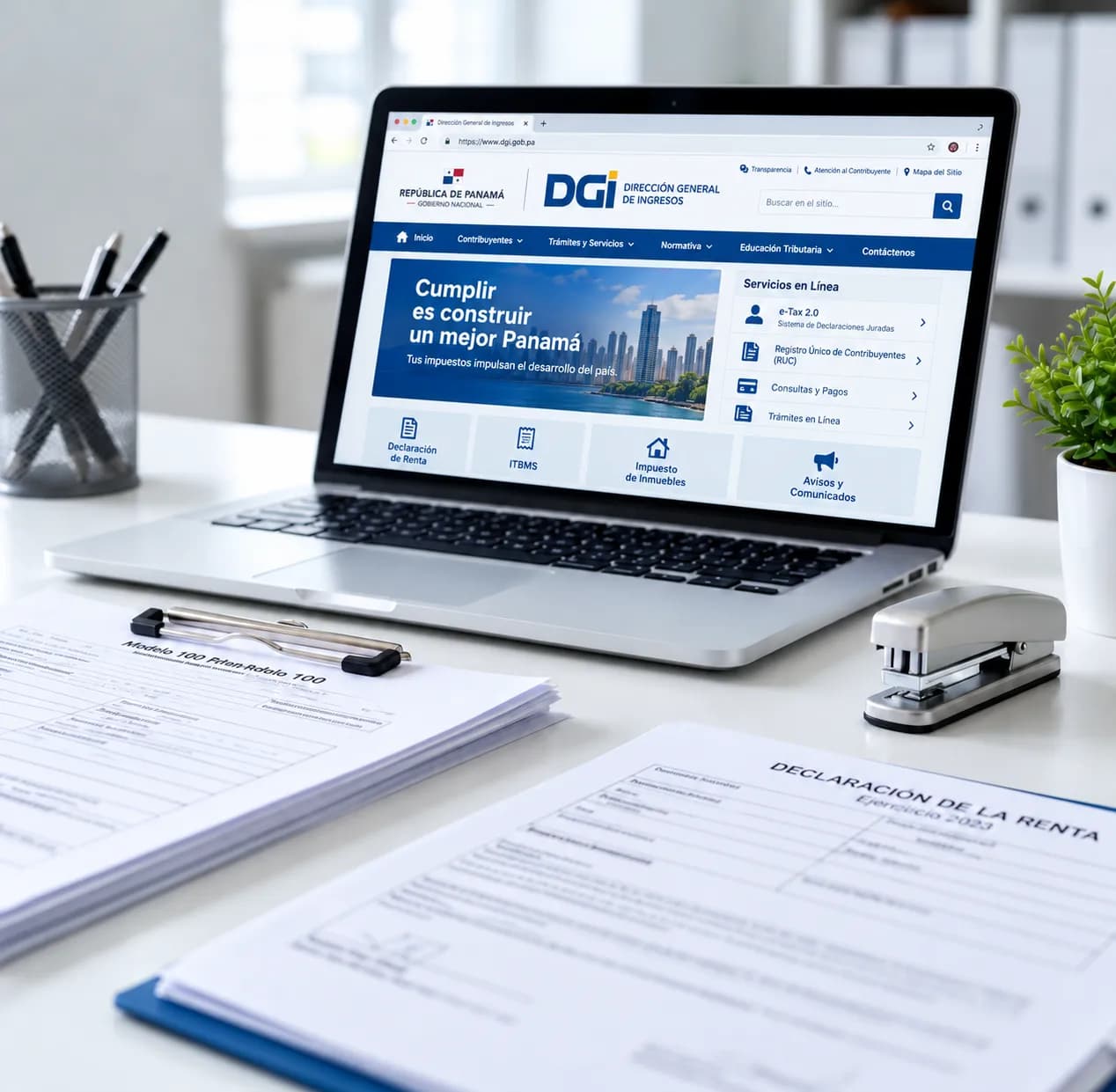
Corporate income tax filing in Panama explained: annual reporting, revenue and expense records, no-activity companies, ITBMS, payroll and municipality.

Compare Panama bookkeeping packages: reconciled records, annual Basic reporting or Premium monthly or quarterly reports, as agreed.