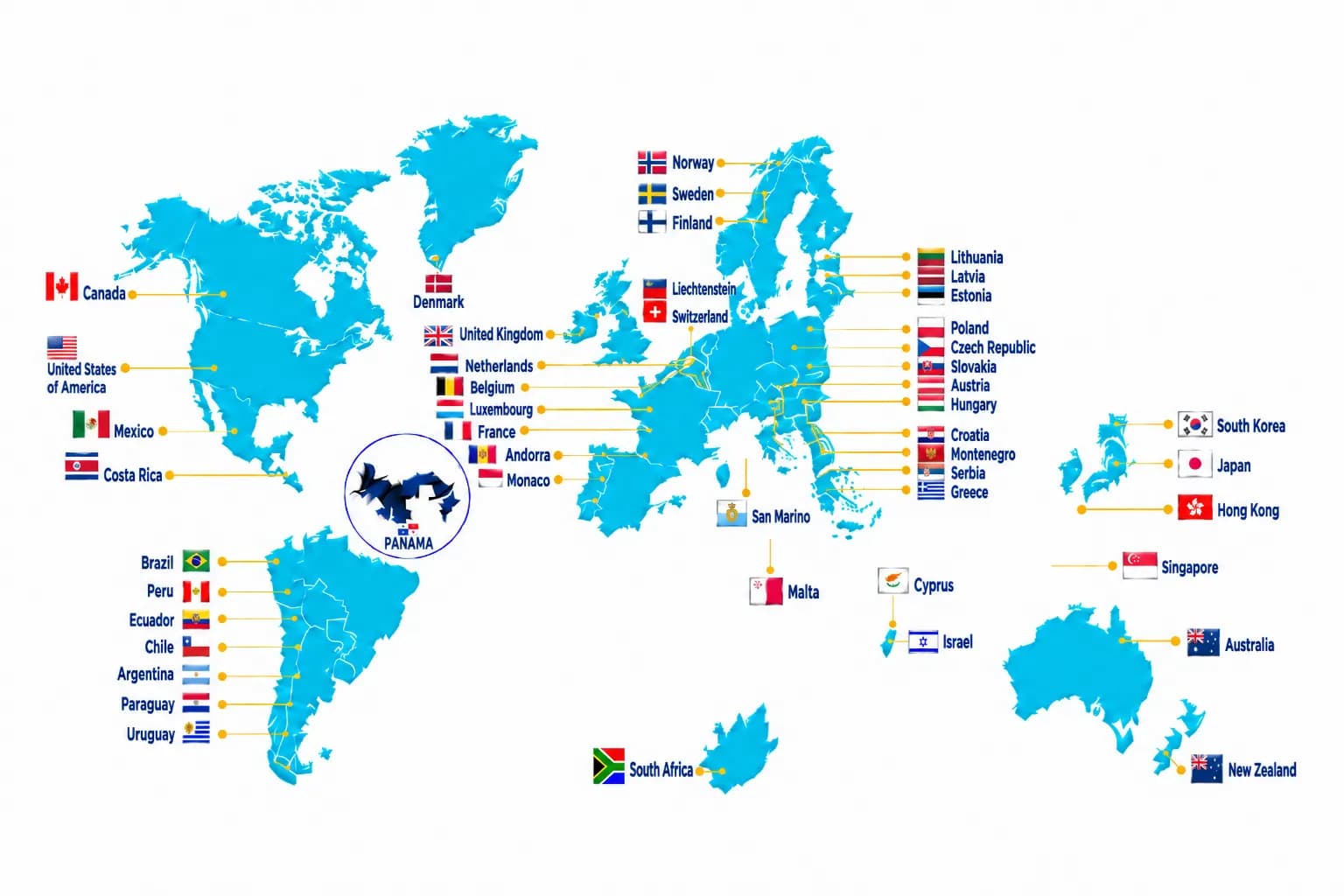
Banking in Panama: Choosing an Account and Preparing Your Documentation

Opening or maintaining a banking relationship in Panama can be connected to much more than receiving payments. For an individual, the relevant factors may include relocation, family arrangements, tax residence, property ownership or investments. For a company or foundation, the bank may also need to understand its business model, beneficial ownership and expected transactions. This guide helps readers identify the type of banking arrangement and documentary preparation that may fit their situation.
The key distinction: choosing an account type is only the first step. A bank or other financial institution independently decides whether to accept the client and what evidence it requires. There is no universal documentation list, approval timeline or guarantee.
What type of banking arrangement am I actually looking for?
The correct starting point is the intended use of the relationship, not a particular bank name. Several arrangements may be relevant to the same person or project:
- Personal current or savings account: ordinary personal receipts, living expenses, transfers, family needs or relocation-related banking.
- Corporate or organizational account: payments and collections connected to a company, foundation or other legal structure, supported by its ownership and activity records.
- Brokerage or investment account: custody and trading of eligible investment products through the appropriate regulated intermediary, subject to its investment and compliance rules.
- Fixed-term deposit: an arrangement for holding funds under specified bank conditions, sometimes considered in investment-related residency planning.
- Multi-currency or international transfer needs: incoming and outgoing payments across jurisdictions, with an examination of supported currencies, transfer corridors and transaction patterns.
- Merchant and payment-processing arrangements: card payments or business collections through providers whose underwriting differs from a standard deposit account.
- Cards and digital banking: debit or credit cards, online access and related tools, which may be separately assessed or unavailable for a particular profile.
An account intended to receive salary is not evaluated in exactly the same way as an account for an international trading company or one linked to a substantial asset sale. The financial institution may request different explanations and supporting evidence.
I am relocating to Panama or already live there. Does my immigration status determine whether I can open an account?
Residence status is part of the banking profile, but it should not be treated as the sole eligibility test. Banks may consider nationality, present country of residence, tax residence, purpose of the account, income, transaction expectations, source of funds and prior financial relationships. A residency card may be relevant evidence, while its absence does not by itself establish that every institution will reject an application.
An individual preparing to relocate should distinguish the documents needed for immigration from those needed by a bank. A document satisfactory for one authority may not meet a bank’s certification, currency, recency or due-diligence rules. Readers exploring a personal relationship can review Personal Bank Account Opening Assistance.
I have a Panamanian company or private interest foundation. Why is opening its account different?
A corporate or foundation account is connected to a legal entity, but a bank normally needs to understand the people and activities behind that entity. Incorporating a company or foundation does not automatically establish a right to a bank account.
Depending on the structure and proposed activity, a financial institution may review:
- Incorporation or registration documents and the current legal representatives or authorized signatories.
- Directors, officers, beneficial owners and controlling persons.
- The commercial purpose of the entity, the products or services involved and the countries where it operates.
- Expected payment volumes, counterparties, clients and suppliers.
- Contracts, invoices, business plans, financial statements or cash-flow projections where requested.
- Tax-residency self-certification and any classification requested for the entity or its controlling persons.
A newly incorporated entity may have no historical financial statements. That does not mean all institutions apply the same alternative evidence; a business plan, projection or commercial record may be requested and should be prepared accurately rather than invented. For the corresponding service scope, see Corporate Bank Account Opening Assistance.
What if I need banking for real estate or a residency-by-investment project?
Real estate purchases, property sales and residency projects can require coordination between the banking file, purchase or sale documentation, professional advice and the movement of capital. The payment account, the seller or buyer, the beneficial owner of funds and any residency applicant may not be the same person. That relationship should be explained clearly.
A fixed-term deposit may be relevant to a specific residency route, while a securities account is a different financial arrangement. These are not interchangeable merely because both involve invested funds. Readers evaluating those immigration routes can examine the separate Qualified Investor Visa — Bank Deposit and Qualified Investor Visa — Securities Investment service pages for their own eligibility, investment and administrative conditions.
Do not assume that opening a bank or brokerage account automatically qualifies a person for residency. Immigration eligibility, eligible assets, investment maintenance and the account-opening decision are separate questions.
What is the difference between source of funds and source of wealth?
Source of funds describes the origin and movement of the particular money entering an account or financing a transaction. Source of wealth explains how the person or entity built its overall financial position over time. They can be related but are not identical.
Examples of underlying activity that may require documentary explanation include salary or professional income, accumulated business profits, company dividends, inheritance, sale of a property, liquidation of investments, a transfer from another regulated financial institution or proceeds associated with digital assets.
The useful evidence depends on the transaction. A property sale may involve a purchase agreement, closing statement and banking trail; accumulated business income may require financial statements, tax or accounting records and historical transfers. A persuasive explanation should be consistent with the actual documents and payment route.
What if part of my funds came from cryptocurrency or other digital assets?
Digital-asset exposure is an additional due-diligence question, not an automatic approval or a blanket prohibition established by this guide. Some institutions may request the history of transactions, exchange account statements, evidence linking the digital assets to their original acquisition and records of their conversion into bank funds. The institution determines what it accepts under its own risk policy.
Organizing records can help professionals assess the documentation, but CitizenResident does not certify the origin of funds or provide cryptocurrency, investment or tax advice.
Why does a bank ask about CRS, FATCA and tax residence?
Cross-border banking may require the account holder to provide tax-residency information and self-certifications relevant to the Common Reporting Standard (CRS) or the Foreign Account Tax Compliance Act (FATCA), as applicable. Corporate structures can face additional questions about entity classification and controlling persons.
Nationality, immigration residence and tax residence should not be assumed to mean the same thing. A person may need professional review of the facts across multiple jurisdictions before completing tax declarations or certifications for a financial institution. The client remains responsible for accurate information, and relevant classifications should be assessed by qualified tax or legal advisers rather than chosen as a formality.
Why might a corporate bank ask for a business plan or financial statements?
An international company may describe itself as a holding vehicle, consulting business, trading enterprise or service company, but the bank must still understand whether the expected transactions fit that description. It may ask for commercial agreements, invoices, client and supplier information, projected cash flows or financial reporting.
Where accounting documents or forecasts are needed, an accountant or CPA may prepare or review them within an independently agreed professional scope. Such documents should reflect genuine operations and explain assumptions, especially for a new entity without historical trading.
Do foreign documents need notarization, apostille or translation?
They sometimes do, but the answer depends on the issuing country, the bank or intermediary’s instructions and the specific document. A foreign public certificate, a notarized power of attorney, a certified passport copy and a translated financial statement may follow different authentication paths.
It is generally more efficient to ask the receiving institution what it will accept before paying for notarization, apostille, legalization or certified translation. A certified copy or apostille does not replace the bank’s separate due-diligence checks.
Can I complete the application remotely, and how long does it take?
Preparation, preliminary review and exchange of supporting documents may sometimes be coordinated remotely. Nevertheless, a financial institution may require original records, a live video interview, in-person identification, locally executed forms, a personal visit or additional verification. Remote availability varies by institution, product and applicant profile.
For the same reason, there is no single reliable approval time across all personal, corporate, brokerage or merchant applications. The timetable can change when the bank requests updated evidence, clarifications about ownership or transaction history, or further internal compliance review.
What does a typical document and compliance workflow look like?
Although the precise sequence varies, applicants can use the following as a planning framework rather than an institution-specific checklist:
- Define the objective: identify whether the need is personal banking, a corporate account, investment custody, a deposit, merchant payments or a combination.
- Describe the applicant: establish residency context, legal structure, signatories and beneficial ownership, as relevant.
- Organize financial background: prepare clear explanations of income, wealth accumulation, expected transfers and transaction counterparties.
- Identify specialist dependencies: determine whether a CPA, lawyer, tax specialist, translator or notary is needed for a particular request.
- Check institution-specific requirements: confirm accepted document formats, certifications, KYC steps and the applicable account product.
- Submit and respond: answer compliance requests consistently and provide additional documentation when properly requested.
- Review post-opening obligations: keep relevant information current and understand operational conditions, reporting responsibilities and account limits.
This roadmap is educational. It does not replace a bank’s official checklist or a professional assessment of a client’s circumstances.
What costs should I distinguish when comparing banking solutions?
A client should distinguish financial-institution charges (for example, account maintenance or transfer fees), third-party expenses (such as certifications, translations or courier services) and professional coordination fees, when a separate service is hired. An investment or fixed-term deposit is capital placed into a financial product under its own conditions, not a professional fee.
Costs, minimum balances, interest terms, currencies, transaction availability and product conditions depend on the selected institution and client profile. The institution’s current written terms should govern any decision.
Which CitizenResident service should I explore next?
CitizenResident lists different services and jurisdiction-specific options for people who need assistance organizing a defined banking project. The pages below describe individual service scopes; they do not guarantee approval or substitute for a bank’s decision.
- Personal account: Personal Bank Account Opening Assistance.
- Corporate or foundation account: Corporate Bank Account Opening Assistance.
- Residency linked to an eligible bank deposit: Qualified Investor Visa — Bank Deposit.
- Residency linked to eligible securities: Qualified Investor Visa — Securities Investment.
For brokerage arrangements, merchant payments, multi-currency facilities and other banking needs not represented by a dedicated published service above, the appropriate scope depends on the provider and the specific objective. The availability of a service in another jurisdiction should be checked in the CitizenResident catalog rather than assumed.
Who makes the final decision, and what can coordination actually achieve?
Banks, brokerages, merchant providers and other regulated institutions independently determine whether to accept an application, what further diligence is necessary and which products or transactions they will permit. Immigration, accounting and tax questions remain the responsibility of the applicable authorities and qualified professionals.
CitizenResident can function as a neutral coordination platform for document flow, client communication and connections among separately engaged professionals. It does not provide banking, legal, accounting, tax, financial, securities, investment, fiduciary or cryptocurrency advice, and it cannot guarantee account opening, approval timing, transfers, cards, merchant arrangements, brokerage onboarding or investment performance.